Asphalt shingles cover more Hartford-area houses than every other material combined. They are on the postwar Capes in Newington and East Hartford, on the Colonials in Glastonbury, and on many of Hartford’s own Victorians, where they replaced slate decades ago. Replacing them is routine work, but the details decide how long the next roof lasts.
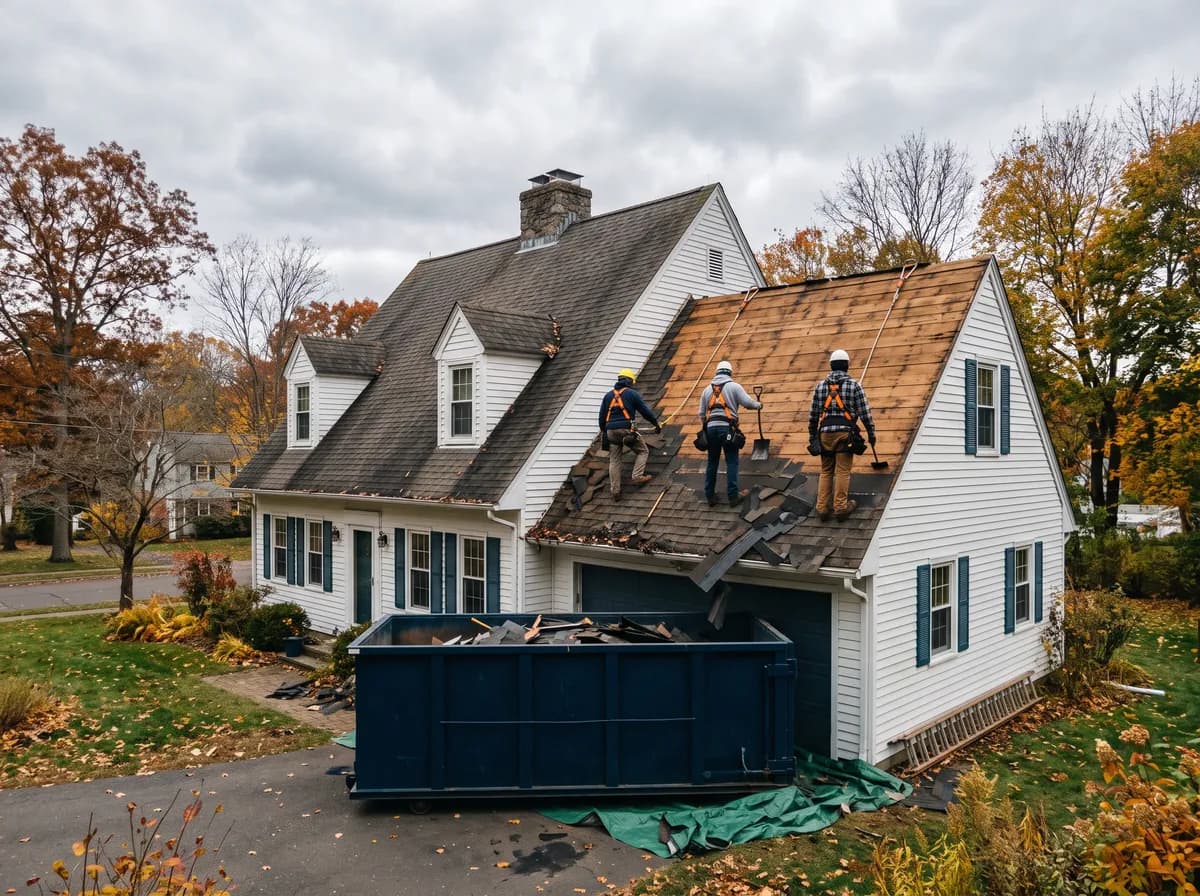
Tear-off first
A proper replacement starts with removing the old roofing down to the wood. That lets the roofer see the decking, which is where most surprises live on older houses:
- Board decking. Houses built before plywood was common often have plank sheathing with gaps between boards. Some roofers sheath over it with new plywood or OSB so the shingle nails have solid wood to grip.
- Soft or stained spots. Long-term leaks rot decking around chimneys, vent pipes and valleys. Those sections are cut out and replaced.
- Hidden layers. It is common to find a second layer of shingles under the first, and occasionally wood shingles under both.
Ask how the roofer handles decking that turns out to be damaged once the old roof is off, and how that is written into the contract. In Connecticut any change to the agreed work should be in writing.
What goes down before the shingles
Ice-barrier membrane at the eaves, and often in valleys and around chimneys and skylights. With an average of a little over 48 inches of snow a season at Bradley International Airport, eave protection matters here more than in most of the country. The ice dam answer explains why the membrane alone is not the whole fix.
Underlayment over the rest of the deck. Synthetic underlayment has largely replaced felt paper.
Drip edge along the eaves and rakes, so water sheds into the gutter instead of wicking behind the fascia.
Flashing at walls, chimneys and dormers. Old step flashing is usually replaced rather than reused. Brick chimneys on older Hartford houses often need counter-flashing cut into the mortar joints.
Ventilation is part of the job
A shingle roof over a poorly ventilated attic runs hot in summer and grows frost and ice in winter. A replacement is the easiest moment to fix that, because the deck is open. Common changes include a continuous ridge vent, opening up soffit intake that was painted or insulated over, and baffles so attic insulation does not block the airflow. Bath fans that dump moist air into the attic should be ducted outside.
Permits, contracts and timing
A full replacement normally needs a building permit. The permit answer explains who issues it and why the contract should say who pulls it. Before signing, check the roofer’s Connecticut registration.
Late spring through fall is the usual season, because shingles seal most reliably in warm weather. Roofers do work through the winter on dry days, and some manufacturers allow hand-sealing in the cold.
Have an asphalt roof that is curling, losing granules or leaking? Call to talk with a roofer who replaces roofs in your town.Mon–Fri 8:30 am–7 pm, Sat 9 am–4 pm (Eastern)
(844) 505-0987Questions homeowners ask
- How many layers of shingles can a Connecticut roof have?
- Building departments in Connecticut generally allow no more than two layers. If a roof already has two, both have to come off before new shingles go on, and most roofers recommend a full tear-off even when only one layer is present.
- Is an ice-barrier membrane required at the eaves?
- Many Connecticut building departments ask for a self-adhered ice-barrier membrane along the eaves, and shingle manufacturers call for it in cold climates. Ask the roofer how far up the roof it will run on your house and confirm the requirement with your building department.
- How long does an asphalt roof replacement take?
- Most single-family houses in the Hartford area are done in one or two working days. Steep pitches, two old layers, rotten decking or a chimney that needs new flashing can add time.