Standing seam metal has gone from barns and porch roofs to whole houses in the Hartford area, especially on farmhouses, Colonials and newer homes in Glastonbury, Bloomfield and the hill towns. It suits the climate: with an average of a little over 48 inches of snow a season at Bradley International Airport, a roof that sheds snow and has no exposed fasteners has real appeal.
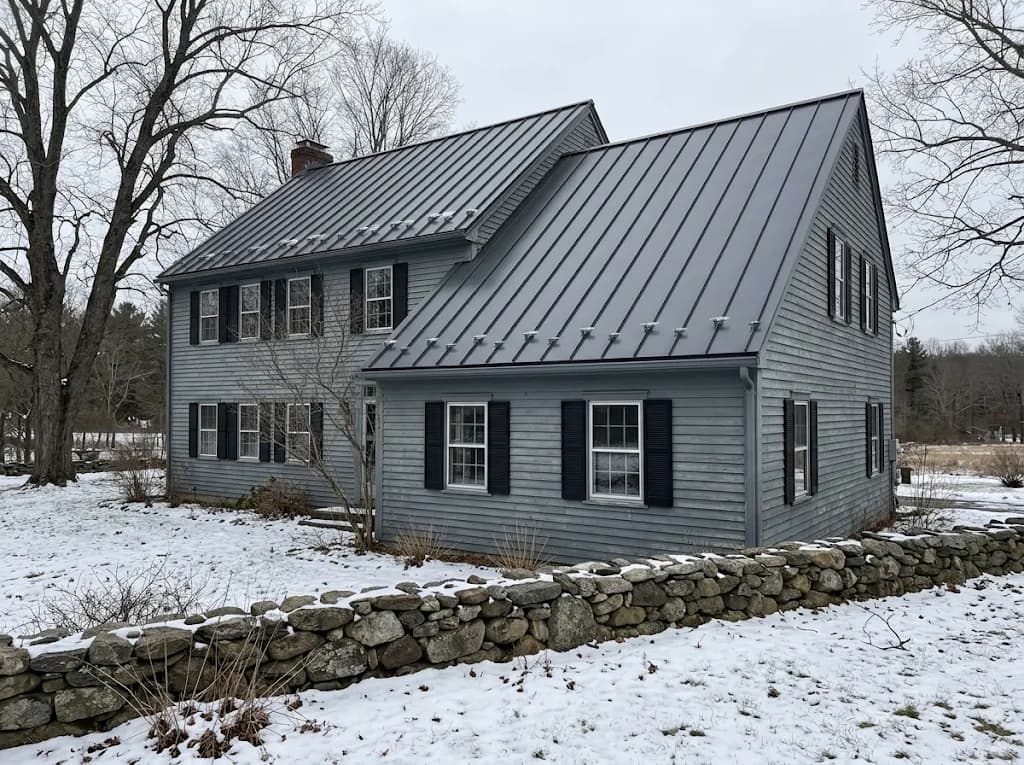
Standing seam vs. screw-down panels
Standing seam panels run from eave to ridge with raised seams that lock or snap together. The fasteners are hidden under the seams, and clips let the panels expand and contract with temperature. This is the system used on houses.
Exposed-fastener panels are screwed straight through the face of the metal with rubber-washered screws. They are common on outbuildings. On a house, the hundreds of washers age and need attention, which is why most residential roofers steer homeowners to standing seam.
Decisions to make with the roofer
- Panel width and seam height. Narrower panels with low seams look more traditional; wider panels read as modern.
- Material. Painted steel is the most common. Aluminum resists corrosion and is lighter. Copper and zinc are specialty roofs for particular houses.
- Finish and color. Ask about the paint system and how it holds color over time.
- Underlayment. Metal roofs need a high-temperature underlayment, and ice-barrier membrane at the eaves is still standard practice here.
- Snow guards. Placement matters as much as the guards themselves. Plan them over entries, decks, driveways and lower roof sections.
Historic districts and metal
In a local historic district, switching to metal is a change of material that normally needs a certificate of appropriateness. Commissions in the region have approved standing seam where it suits the house, and turned it down where it does not. Bring photos of the house and the product to the hearing. The permit answer covers the order of steps.
Thinking about metal for your next roof? Call to talk it through with a roofer who installs standing seam in Hartford County.Mon–Fri 8:30 am–7 pm, Sat 9 am–4 pm (Eastern)
(844) 505-0987Questions homeowners ask
- Are metal roofs noisy in the rain?
- Over a solid wood deck with underlayment and an insulated attic, a metal roof is not much louder than shingles. The loud metal roofs people remember are usually panels on open framing over barns and sheds.
- Do metal roofs need snow guards in Connecticut?
- On most houses, yes, at least above doors, walkways, driveways and lower roofs. Snow slides off metal in large sheets, and snow guards hold it in place so it melts off gradually.
- Can a metal roof go on a house in a historic district?
- Sometimes. Local historic district commissions decide case by case, and some have approved standing seam roofs where the panel width, seam height and color suit the house. Approval has to come before the building permit.