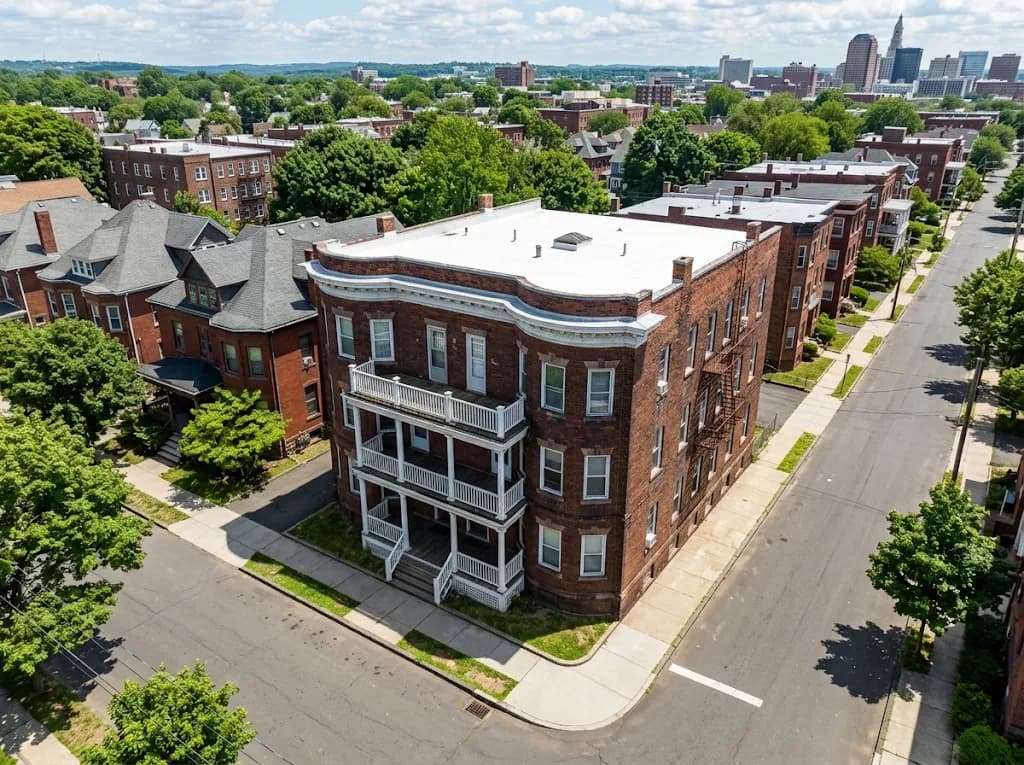
Hartford has a building type found almost nowhere else: the Perfect Six, a three-story brick building with six apartments, built in large numbers in the first decade of the 1900s. The National Register nomination for one Frog Hollow block calls it the dominant building type there, often with double bow fronts, three-story wooden porches and a sheet-metal cornice. Brick multi-family buildings like these, along with three-families and the porches and additions on countless houses, are where low-slope roofs are found in the Hartford area.
Why flat roofs on old buildings fail the way they do
A low-slope roof hides behind the parapet and cornice, so problems go unnoticed until water shows up on the top floor. By then it has often been getting into the masonry and framing for years. Wait long enough and the building itself is at risk: 87–89 Atwood Street, a 1911 Hartford building designed by George Zunner, lost its back wall after years of neglect and a leaking roof, and its restoration kept only the facade.
The usual weak points:
- Ponding. Water that sits on the roof for days finds every seam. Sagging framing and clogged drains are the common causes.
- Parapet flashing. Where the membrane turns up the inside of the parapet, the flashing and the coping on top have to shed water. Cracked coping lets water straight into the wall.
- The cornice. Sheet-metal cornices on the street side collect water if their tops are not covered and pitched correctly.
- Penetrations. Old vent stacks, chimney flues, roof hatches and condenser stands all need their own flashing.
Membrane choices
EPDM. A synthetic rubber sheet, usually black, fully adhered or mechanically fastened, with taped seams. Long track record in the Northeast.
TPO. A white thermoplastic sheet with heat-welded seams. The white surface reflects summer heat, which top-floor tenants notice.
Modified bitumen. Asphalt-based rolls, torch-applied or self-adhered, often in two plies. Tough under foot traffic.
What a full replacement includes
- Removing the old roofing down to the deck, and replacing rotted decking
- Correcting slope with tapered insulation where water ponds
- New membrane, with flashing up the parapets and around every penetration
- New or reset metal coping on the parapets, and attention to the cornice tops
- New drain bodies or scupper liners, and leaders checked for blockage
The participating roofers focus on houses and smaller multi-family buildings. If you own a large apartment building, mention it when you call.
Water coming through a top-floor ceiling? Call to talk with a roofer who replaces flat roofs on Hartford multi-family buildings.Mon–Fri 8:30 am–7 pm, Sat 9 am–4 pm (Eastern)
(844) 505-0987Questions homeowners ask
- Which membrane is most common on Hartford multi-family roofs?
- EPDM rubber, TPO and modified bitumen are all common. The right one depends on the roof's drainage, how much foot traffic it gets, what is on it (condensers, vents, hatches) and what the roofer installs regularly. Ask why a roofer recommends one over another for your building.
- Should insulation be added when a flat roof is replaced?
- Often, yes. Tapered insulation boards can improve drainage toward the drains or scuppers, and added insulation makes the top-floor units easier to heat. The building code's energy rules can also apply when a roof is fully replaced, so ask the roofer what your building department requires.
- Do porch and addition roofs count as flat roofs?
- Usually. Back-porch roofs on three-family houses and low-slope roofs over additions and dormers are replaced with the same membranes. Many roofers replace them at the same time as the main roof so the flashing between the two is done once.